 Dharma Vision LLC
Dharma Vision LLC
publishe
FAQ
Frequently Asked Questions about “The Courtesan and the Sadhu (a novel about Māya, Dharma, and God)" by Mysore Prakash
- What made you write this novel?
My family has followed Sanatana Dharma (Eternal Dharma) as far as recorded history goes. My children often asked me to explain the fundamental tenets of Dharma, and the relationship between the theology of Dharma and God. As I read various scriptural texts and started making notes to explain the basic tenets of Dharma to my kids, it occurred to me that the best way to explain might be to embed it within a fictional novel. The idea was to make the novel interesting enough so one can grasp the true meaning of God’s Dharma in the end.
- Does the reader have to know about the fundamental tenets of Dharma?
- The reader need not know anything related to Dharma. They will learn about Dharma as they progress in the novel.
- What is Māya?
- In Dharma theology, God has two modes of presence in the material world. The first is Māya, and the other is Brahman. Māya is God’s material energy. That is, the energy which keeps the material world in motion. Love, hate, greed, compassion, and all other forces you can list come under Māya. Māya is what keeps us attached to the material world and takes us away from God. Māya is analogues to the gravitational force that keeps us tethered to earth.
God’s spiritual presence in this world is Brahman. When one reaches the Brahman plane, you are free of the influence of Māya. - What is Dharma?
- In simple terms, Dharma is righteousness. However, the real test for a “righteous” tenet or spiritual value is that it transcends beyond the dimensions of time and space.
- What is the relationship between God and Māya?
- God is the controller of Māya. You can think of Māya as a hurdle that we need to pass to reach God. Everyone other than God is under the influence of Māya. It is impossible to overcome Māya without surrendering to God (“Surrender unto Me” Bhagavad-Gita 18.66)
- Is Dharma the same as God?
- No. There is Dharma, and there is dharma. Dharma conforms to God’s rules, where as dharma may conform to man made rules (for example rules according to ancient Manu as in Manu-Smriti).
- Are the historical events accurate?
- This is not a historical novel in the classical sense. While I have introduced many historical characters in the novel, not all events described are historically accurate.
- What is the significance of Kautilya in Part 1?
- Kautilya is the author of Artha Shastra, a treatise on statecraft (political, economical, diplomatic, and military matters in governing a large Empire). The exact date of Artha Shastra is a matter of intellectual debate, and historians place it between 300 BCE and 200 AD. According to the Indian tradition, Chandra Gupta was a protégé of Kautilya. Chandra Gupta establishes the first Empire spanning the entire Indian subcontinent with Kautilya’s help.
- What is the significance of Chandra Gupta in Part 1?
- Historical Chandra Gupta was the first ruler of the Maurya dynasty (320-298 BCE). He built the largest Empire ever established over the entire Indian subcontinent. He comes to power by overthrowing the Nanda dynasty. He defeats Seleucus, the Greek general who inherits the eastern part of Alexander’s Empire, and incorporates the territories of Indus valley and Bactria into the Mauryan Empire. The Mauryan dynasty ruled India during 322-185 BCE.
- What is the relationship between Manu in the novel and ancient Manu?
- Manu is the main character in Part 2 of the novel. He is born into a warrior class with impeccable military credentials. However, his life takes an unexpected detour and he abandons his martial path, and becomes a spiritual seeker.
Ancient Manu is the first man created by God in Dharma theology. He is the progenitor of humankind. He is also the author of Manu-Smriti in which he specifies the laws or codes for followers of Dharma. - What is the significance of Chitralekha in Part 2?
- Chitralekha is a casualty of war. Her story is one of abuse and suppression of feelings. She is a classic example where suffering is a consequence of someone else succumbing to the forces of Māya. This is an illustration of how our collective Karma comes into play.
- What are Vedas?
- Vedas are the fundamental scriptures in the Dharma tradition. There are four Vedas, the oldest being Rig-Veda which is considered the oldest text in an Indo-European language. However, for followers of Eternal Dharma, Vedas are timeless and are Divine Revelation.
- What is the relationship between Bhagavad-Gita and Vedas?
- Bhagavad-Gita is the book of Revelation in the Dharma tradition. Theologians consider it the summation of Dharma theology, and thus the most sacred Scripture for the followers of Dharma. God Himself descended on earth as Lord Krishna to distill the Vedas for us.
- How is Eternal Dharma different from Buddhism and Jainism?
- All three are dharmic religions and share many tenets. They all preach peace and love for nature and animals. Indeed, all three traditions either encourage or mandate vegetarian diet. Yoga and meditation are a key part of all three religions. In addition, Karma and re-incarnation are fundamental beliefs in all dharmic traditions. However, there is one key difference. Eternal Dharma is all about Creator God and Dharma as specified by God, while Buddhism and Jainism do not believe in a Creator God.
- When will the novel published?
The novel is now published and can be purchased by clicking here.
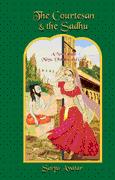
Our first publication: "The Courtesan and the Sadhu (a novel about Maya, Dharma, and God)," a spiritual novel by Mysore Prakash (Originally published under pen name Satya Avatar) is now available. Click here to order!
Copyright 2009 Dharma Vision LLC. All rights reserved.
Dharma Vision LLC
publishe